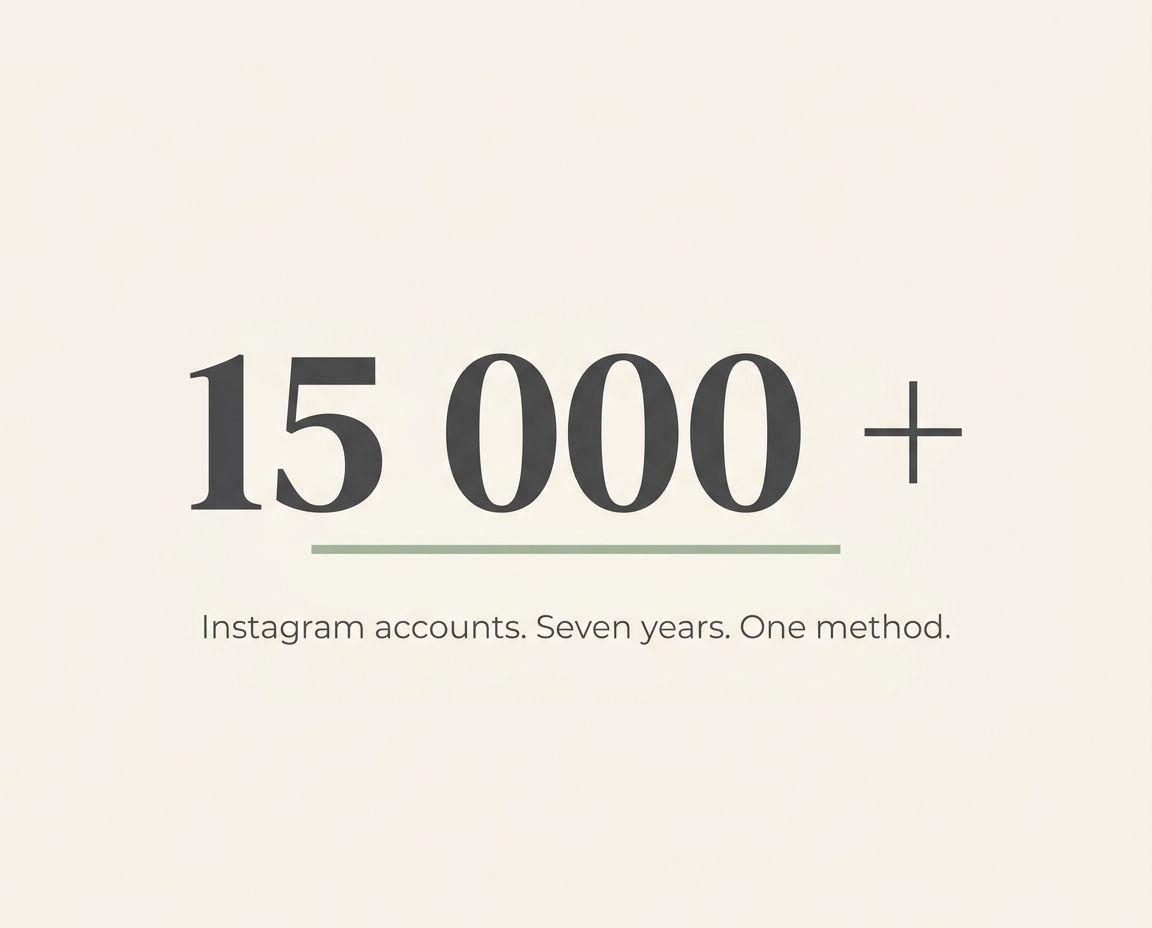



If you've searched for "Instagram growth service" recently, you've seen the problem. The results page is a mess. Dozens of companies, each with a different promise, different pricing, and different definitions of what they actually do. Some grow accounts. Some sell fake followers. Some run software that gets your account banned. All of them call themselves "organic."
For a business owner or creator trying to actually grow their Instagram, the market is genuinely confusing — and getting the choice wrong can cost you money, followers, and in some cases your entire account.
This is the honest, definitional guide. What an Instagram growth service actually is, the four fundamentally different types on the market, what to look for, and the red flags that separate a real service from a scam. No pitching, no fluff — just the framework to make a confident decision.
A quick note: yes, we run one of these services — here's how ours works if you want context. But this article is a framework for evaluating any Instagram growth service, ours included. Judge it on the framework, not the pitch.
What an Instagram growth service actually is
At its simplest, an Instagram growth service is a company or tool that helps you gain more followers on Instagram without you doing all the work yourself.
That's the promise. The delivery methods vary wildly.
Some services put your profile in front of real people through active engagement. Some run AI that promotes your content externally. Some sell you inflated follower counts made up of fake or dormant accounts. Some run automation software that mimics your activity from your login credentials.
The service category as a whole exists because organic Instagram growth is genuinely hard and time-consuming. Growing an account from scratch takes 2–3 hours a day of consistent, targeted work — content plus engagement — which most business owners simply don't have. Growth services promise to handle the engagement half of that equation, so you can focus on the content.
The question isn't whether the category is legitimate. It is. The question is which type of service you're actually buying.
The four categories (and which ones are worth your money)
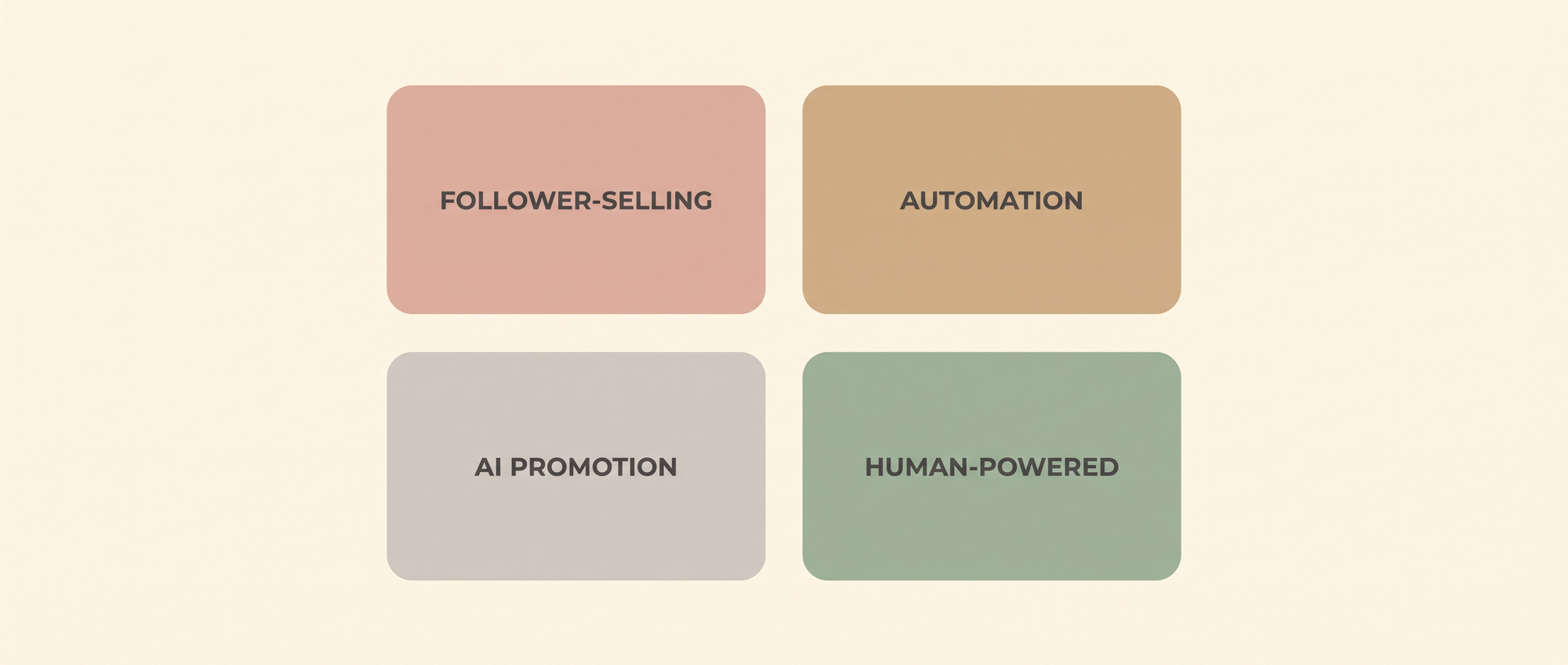
Every Instagram growth service on the market falls into one of four categories. Understanding which is which is the single most important thing to get right.
Category 1: Follower-selling services
What they do: Sell you a fixed quantity of followers for a one-off payment. $50 for 10,000 followers is the classic example.
How they work: These services deliver bot-generated or dormant accounts to your follower count. The followers appear on your profile within hours. They don't engage. They don't buy. Many disappear within weeks.
Examples: Media Mister, Famoid, Twicsy, iginstant, some tiers of Path Social based on customer reports.
Should you use one? No. In addition to the ethical problem, this is now the most dangerous option in 2026. Instagram's May 2026 bot purge wiped millions of fake accounts overnight, and accounts that had bought followers in previous years lost 30–60% of their follower base and saw engagement rates crater. Meta's algorithm now actively penalises accounts with high fake-follower ratios. (We covered the full breakdown in The Real Cost of Buying Instagram Followers.)
Cost: $10–500 per one-off purchase, depending on the "quality tier" — though even the premium tiers are usually still fake.
Category 2: Automation software
What they do: Software that logs into your Instagram account (either through your password or a browser extension) and automatically follows, likes, and comments on target accounts on your behalf.
How they work: You set the targeting parameters — hashtags, competitor accounts, locations — and the software runs actions from your account 24/7 (or as often as Instagram will allow).
Examples: Kicksta, Nitreo, some tiers of Upleap, Growthoid, older versions of many "AI-powered" services.
Should you use one? In 2025 and earlier, sometimes. In 2026, no. This is the category that got obliterated by Meta's clarified automation policy. Activity-based automation — any tool that directly controls your account to perform actions like auto-liking, following, or commenting — is now explicitly and universally banned. An estimated 40% of tools that existed in 2024 have become obsolete overnight. Accounts detected using them face escalating penalties: comment throttling, follow restrictions, and full account suspension for repeat offenders.
Cost: $19–99/month typically.
Category 3: AI-driven external promotion
What they do: These services promise to put your content in front of the right audience through "AI targeting" without accessing your account directly.
How they work: The exact mechanism is often opaque — most of these services don't clearly explain how their AI actually delivers followers. Some do run legitimate paid promotion behind the scenes. Others deliver bot-driven results despite claiming to be organic. Reviews and BBB complaints across the category suggest wildly inconsistent quality.
Examples: Path Social, some tiers of Upleap's newer offering, several newer platforms.
Should you use one? Cautiously, if at all. The category is inconsistent — genuine AI-driven marketing exists, but so do plenty of services in this category that dress up follower-selling as "AI-powered organic growth." Public review ratings across the category range from 3.4 to below 3.0.
Cost: $39–129/month typically.
Category 4: Human-powered managed services
What they do: Real people on a growth team engage with your target audience on your behalf, manually, from your Instagram account. Same activity Instagram rewards when you do it yourself — just handled by a professional.
How they work: You share your account access with the team. A dedicated Campaign Manager sets up targeting based on your niche, location, and audience. Team members log into your account daily on real devices and manually follow, like, and comment on profiles that match your target audience. Real people see the notifications, visit your profile, and — if your content is good — follow.
Examples: Social Boost, Ascend Viral, Growthoid (partially, on their human-oversight tier), OniGrow, Flock Social.
Should you use one? This is the safest and most sustainable option in 2026. It's the only method that survived every algorithm change, every automation policy update, and every bot purge because it is what Instagram itself rewards — real human engagement from a real account. The catch: it's the most expensive category, because real humans doing real work costs more than software.
Cost: $99–249/month typically.
What actually changed in 2026 (and why it matters)
Three shifts have redrawn the landscape:
1. Meta's automation policy overhaul (early 2026). Instagram now explicitly bans all activity-based automation tools. Detection is more sophisticated than at any previous point. Any service still running follow/like/comment automation from your account is putting your account at active risk.
2. The May 2026 bot purge. Meta ran a platform-wide sweep and wiped millions of fake accounts overnight. Bot-sourced followers saw retention rates of 15–40% over 90 days, compared to 85–95% for real ones. Any growth service still delivering bot followers is delivering assets that will evaporate within months.
3. The algorithm shift toward real engagement signals. Saves, shares, and meaningful comments now carry dramatically more weight than likes or follows. This makes bot-generated engagement nearly worthless — bots don't save, share, or leave real comments. Only real human engagement produces the signals the current algorithm actually rewards.
The consequence is straightforward: services that were "fine" in 2023 are now actively dangerous, and the only category that reliably works long-term is human-powered managed service.
What to look for (the checklist)

If you're evaluating a service, run it through these six checks:
1. Is the delivery method clearly explained?
Real services can explain, in plain English, exactly how they grow your account. "AI targeting" or "proprietary algorithm" with no further detail is a red flag. Ask specifically: "Who — or what — is doing the following, liking, and commenting?"
2. Are there dedicated humans on your account?
The safest option in 2026 is real people, manually, from your account. If the service uses software to automate actions from your account, that's the banned category. If nobody accesses your account and everything is external "AI promotion," ask for verification of how those followers are actually acquired.
3. What do the last 30 days of reviews say?
Older reviews can be misleading — services change over time. Filter to the most recent reviews. Look for patterns: are complaints about fake followers, billing issues, or unresponsive support? Those are structural problems, not one-off customer complaints.
4. Is there a Campaign Manager or account manager you can actually talk to?
Real services assign a real human as your point of contact. If the only support option is a chatbot or a generic email address, you're dealing with a lower-touch operation — often the ones that struggle to deliver quality.
5. What's the money-back guarantee?
Real services offer at least a 30-day money-back guarantee. Shorter windows (7 days is common in this space) don't give you enough time to actually see whether the growth is real. If there's no guarantee at all, walk away.
6. Is the growth rate realistic?
Anyone promising "10,000 followers in a week" is selling you bots. Real, targeted growth from a real service produces 300–500 relevant followers a month. If the promise is dramatically higher than that, the followers being delivered aren't real.
Red flags that mean walk away
Three deal-breakers, regardless of how good the marketing looks:
"No password required." In 2026, this often signals AI-external promotion (Category 3) — which can be legitimate but is also where most of the "delivers fake followers despite promising organic" complaints come from. It's not automatically bad, but it means the service isn't doing real engagement work from your account.
"Fully automated" or "runs on autopilot." Automation from your account is banned by Instagram. Any service still advertising this as a feature in 2026 is either lying about how they work or actively putting your account at risk.
Annual-only pricing with no monthly option. Services that push hard toward annual billing before you've seen results are hiding retention problems. Real services let you try month-to-month first.
What it should cost (honestly)
Rough market benchmarks in 2026:
- Human-powered managed services: $99–249/month
- AI-driven promotion: $39–129/month
- Automation software (now banned, avoid): $19–99/month
- Follower-selling (avoid entirely): $10–500 per one-off purchase
Human-powered services cost more because real people are doing real work. That's not a markup — it's what the labour actually costs. Services in this category run on 2–3 hours of manual work per client per day. There's no way to deliver that for $20/month, regardless of what any marketing site claims.
A quick honest word on Social Boost
Since we're one of these services, it's worth being upfront: Social Boost is a Category 4 service. Real people on our team, manually engaging with the right accounts in your niche, every weekday, from your account. We've been doing this since 2019, for over 1,600 clients across 65+ countries.
Premium sits mid-range for the human-powered category. Turbocharged sits above it — it runs at higher volume, 250 to 800+ followers a month against Premium's 150 to 500+, with a senior growth manager, advanced targeting and strategic content review. We're not the cheapest option — real human work isn't cheap — but our whole model is built on the one method that has consistently worked through every platform change and every bot purge since we started.
If that's the category you're looking for, here's how it works. If a different category makes more sense for your situation, we'd rather you found the right service than the wrong one.

The simple version
- Four categories exist: follower-selling (avoid), automation software (banned, avoid), AI external promotion (cautious), human-powered managed (best).
- Only human-powered services align with Instagram's 2026 policies and reward structure.
- Check delivery method, human presence, recent reviews, real support, real guarantee, and realistic growth rates.
- Watch for red flags: "no password" without explanation, "fully automated," annual-only pricing.
- Real human work costs $99–249/month. Cheaper isn't cheaper — it just isn't the same product.
Picking the right Instagram growth service in 2026 comes down to one question: is a real person doing the work? Everything else follows from that answer.
If you'd like to work with a service where the answer is yes — real people, manually, targeted to your niche — that's what we do.
See plans → from $129/month, no contract, cancel any time. 30-day money-back guarantee.