

Most Instagram content calendars die within two weeks.
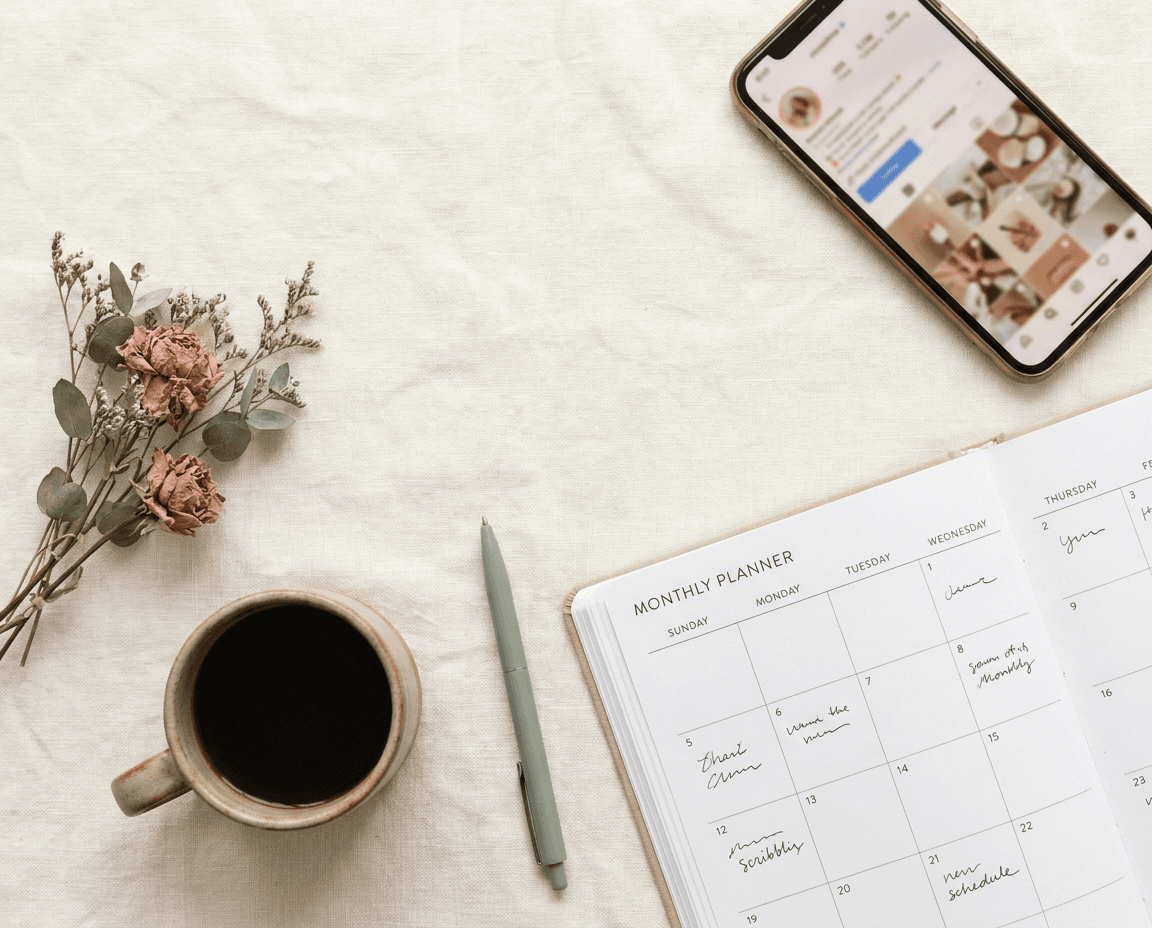
You spend a Sunday afternoon mapping out four pristine weeks of posts. Beautiful spreadsheet. Colour-coded by format. Detailed captions roughly outlined. By Wednesday of week one, real life happens — a client emergency, a slow morning, a Reel idea that didn't shoot quite right — and the calendar starts slipping. By week three, you've abandoned it and you're posting whatever you can scrape together that day.
This is not a discipline problem. It's a design problem. Most content calendars are built for a perfect version of you who doesn't exist, and they collapse the moment real life touches them.
The calendars that survive — the ones that actually produce consistent posting and real growth — are built differently. They're realistic, modular, batched, and flexible by design. This is how to build one of those.
A quick note: if you'd rather have a team handling the growth side of Instagram while you focus on creating the content, here's how our service works. Otherwise, read on.
Why content calendars fail (and why yours probably did)
Before the template, the diagnosis. Calendars fail for five predictable reasons:
1. They're too ambitious.
Most calendars budget for daily posts, 5+ Reels a week, and pristine Stories every day. For one person juggling a business, this is fantasy. Within two weeks, the gap between plan and reality becomes demoralising, and you abandon the whole system.
2. They're built post-by-post instead of pillar-by-pillar.
"Monday: motivational quote. Tuesday: behind-the-scenes" is not a strategy. It's a costume. Without underlying content pillars — the 3–5 topics you actually want to be known for — you end up with a calendar full of disconnected posts.
3. They don't account for batching.
You can't film a Reel on Monday morning, write a carousel Tuesday afternoon, and shoot Stories Wednesday evening. That's not how anyone with a real life produces content. Sustainable calendars batch creation into focused blocks.
4. There's no flexibility built in.
Real calendars need buffer space — for trending topics, client wins, last-minute opportunities, sick days. The ones that try to plan every slot down to the caption choke on the first interruption.
5. They optimise for posting, not engagement.
The biggest unforced error. The calendar tells you when to post but ignores what wins in 2026 — and the answer to that has completely changed.
The five things a 2026 calendar has to account for
Before plotting a single post, the underlying system has to handle these realities:
Frequency: 3–5 feed posts per week, daily Stories
Buffer's 2026 analysis of 9.6 million Instagram posts confirms what most working creators have already learned: aim to share Instagram in-feed posts three to five times per week and post at least one Instagram Story per day. TrueFuture Media
Posting more often increases visibility, but with steeply diminishing returns. The data from Later cited in 2025 research found that nano accounts with up to 10,000 followers post twice per week, micro accounts with up to 100,000 post three times per week, and mid accounts with up to 500,000 post five times per week. TrueFuture Media
In other words, posting frequency scales with account size — not the other way around. You don't post seven times a week into a small account and earn growth; you grow into the right to post more often as your audience expands.
Format mix: weighted toward Reels for reach, carousels for engagement
The working mix in 2026:
- 3–4 Reels per week (for discovery and new follower growth)
- 1–2 carousels per week (for engagement and saves)
- Daily Stories (for relationship and DMs)
- Occasional static posts (for milestones and brand moments)
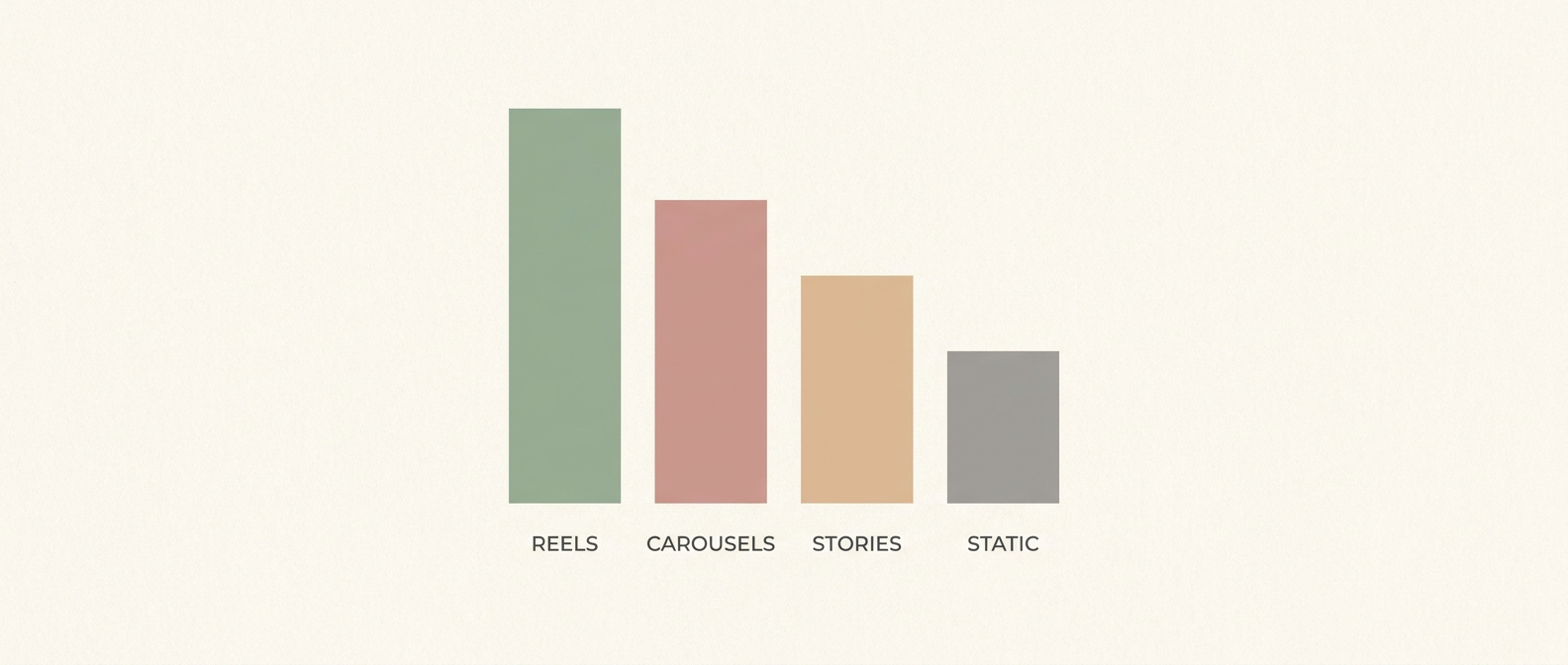
Reels reach roughly 2× more people than carousels or static posts. But carousels generate roughly 109% more engagement per impression than Reels. Use both. They do different jobs.
Timing: Wednesday and Thursday evenings outperform everything
Buffer's analysis of 9.6 million posts found a clear pattern: evening hours (6 p.m. to 11 p.m.) consistently outperformed other time slots, with Wednesday and Thursday showing the strongest overall performance. Friday and Saturday are the worst days to post — significantly lower engagement across all time slots. Yahoo!
Your specific audience may vary (check Insights → Total Followers → Most Active Times for your real numbers), but if you're working with no data, that's the safe default.
Content pillars: 3–5 topics, not endless variety
Before plotting individual posts, lock in what you want to be known for. Examples of strong pillar sets:
- For a nutritionist: Education / Client wins / Behind the scenes / Mythbusting / Recipes
- For an e-commerce brand: Product / Customer stories / Behind the brand / Educational / Trending
- For a coach or consultant: Frameworks / Case studies / Personal stories / Industry takes / Offers
Every post in your calendar has to fit one of those pillars. Anything that doesn't gets cut. This is what stops your calendar from devolving into a junk drawer of random content.
Engagement signals: saves and shares matter more than likes
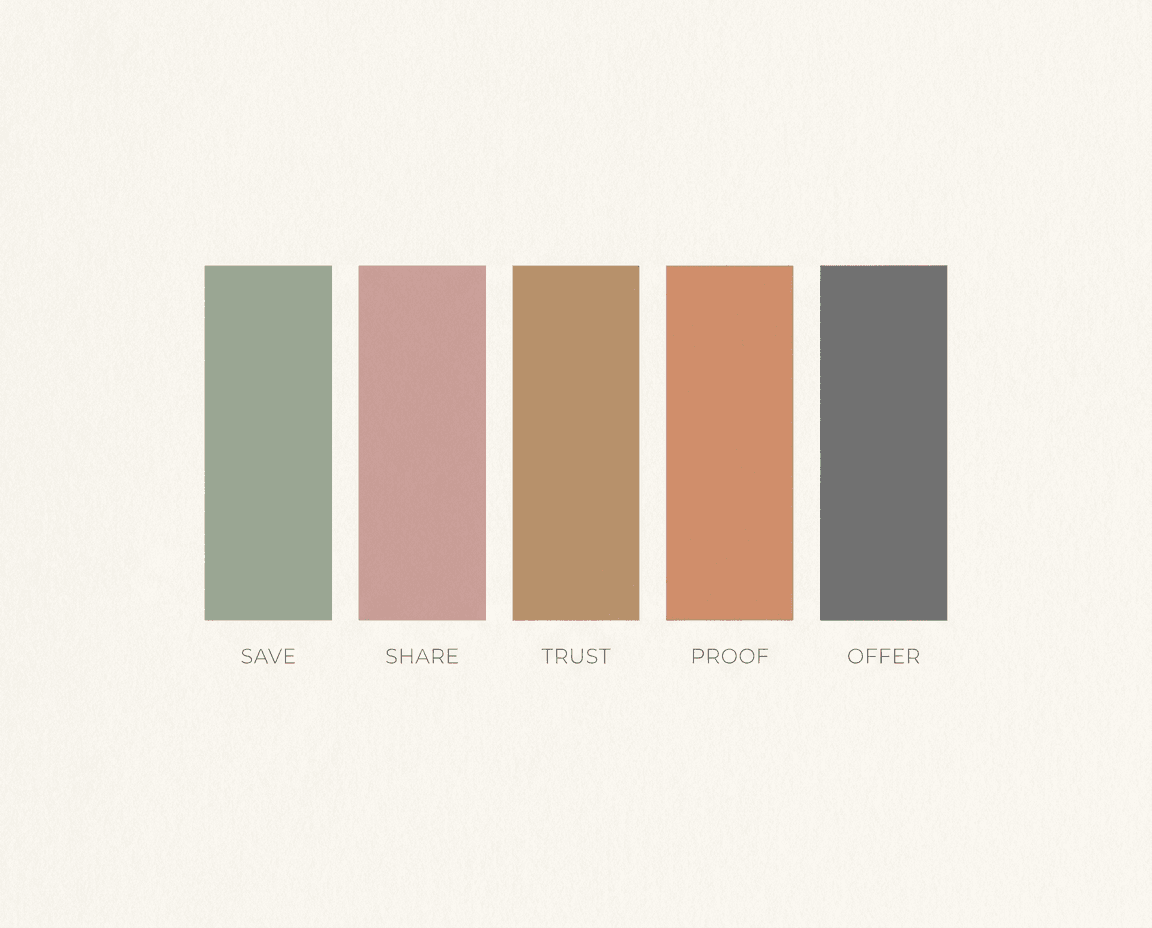
Instagram's algorithm has been formally rebalanced. Saves are now worth roughly 10× a like in distribution weight. Shares (DMs of your post) are worth roughly 15× a like. (We covered the full breakdown in Why Saves Beat Likes.)
This changes what your calendar should bias toward. Save-worthy content (educational, reference, useful) and share-worthy content (specific, relatable, "send this to a friend") should be the foundation. Pretty-but-utility-free content should be the exception, not the rule.
The 30-day calendar template

Here's the working template, built on the five foundations above. It posts 14 feed pieces + daily Stories over 30 days — sustainable for one person, dense enough to compound.
Weekly rhythm
| Day | Format | Pillar role |
|---|---|---|
| Monday | Reel | Educational (save-bait) |
| Tuesday | Story sequence only | Engagement / poll / DM-driver |
| Wednesday | Carousel | Deep educational or framework |
| Thursday | Reel | Personality / behind-the-scenes |
| Friday | Story sequence only | Casual / weekend mood |
| Saturday | Static or Reel | Brand moment, client win, light content |
| Sunday | Off, or planning Stories only | Recharge / week ahead preview |
That's 4 feed posts per week × 4 weeks = 16 feed posts in 30 days, with Stories every day. Right inside the 3–5 per week sweet spot.
Posting times (default if no audience data yet)
- Reels: 7 pm (Mon/Thu)
- Carousels: 12 pm or 7 pm (Wed)
- Static / Saturday post: 8 pm
- Stories: spread across the day — one morning, one afternoon, one evening
Refine these once you have 30 days of Insights data showing when your audience is actually online.
The 4-week pillar rotation
Rotate which pillars get used each week so nothing dominates:
- Week 1: Education-heavy (build authority)
- Week 2: Personality-heavy (build trust)
- Week 3: Proof-heavy (client wins, case studies, testimonials)
- Week 4: Conversion-heavy (light offer, soft pitch, FAQ-style content addressing objections)
Across 30 days, your audience sees the full range of who you are — credible, human, proven, sellable.
The batching workflow that actually makes this sustainable

A calendar without a creation system is just a checklist.
The working approach: one batch day per week, two hours.
- Sunday afternoon (2 hrs): Shoot all the visuals for the upcoming week. 2 Reels filmed back-to-back, 1 carousel shot or designed, any photos needed. Caption drafts written into a notes app for each post.
- Monday morning (30 mins): Edit Monday's Reel, write final caption, schedule the rest of the week using your scheduler of choice (Later, Buffer, Meta Business Suite — all work).
- Throughout the week: Stories captured live (mostly phone-only, no editing needed). Comment replies within the first hour where possible.
Two hours of focused batching plus 30 minutes of editing replaces 7+ hours of daily content scramble.
The accounts that scale on Instagram aren't necessarily more creative — they're more systematised. Batching is the difference.
What to track, and what to ignore
Most people track the wrong metrics and miss the ones that move the needle.
Track these:
- Saves per reach — the strongest indicator of save-worthy content
- Shares (sends) per reach — the strongest signal for new follower growth
- Profile visits per post — the leading indicator of follower growth
- Story replies and DM volume — the depth of relationship being built
- Most active times in your audience — refines your posting schedule monthly
Stop obsessing over:
- Like count
- Follower count (as a vanity metric — measure growth rate instead)
- One viral post (or one bad post)
Review the metrics monthly. Adjust the calendar for what's working. Don't redesign the whole system after every disappointing post.
The part nobody tells you about content calendars
Here's the honest part.
You can build the world's best content calendar. Stick to it for six months. Post 3-5 times a week, every week, at the right times, in the right formats, with proper pillars and batching — and still grow slowly.
Because content alone isn't growth. Content is the fuel. Growth happens when your content gets seen by the right people in the right numbers — and that side of the work doesn't happen automatically just because your calendar is full.
The accounts that compound fastest in 2026 do both: they run a tight content calendar like this one and they actively put their profile in front of the right people in their niche every day. Real engagement with real accounts that match their target audience. That second half is what triggers the algorithmic distribution your content was built to earn.
It's also the part most business owners don't have time for. That's why we built Social Boost — real people on our team handle the engagement side manually, every weekday, while you focus on running your calendar. The two halves working together is what produces consistent 300–500 relevant followers a month.

The simple version
- Stop building aspirational calendars — build sustainable ones (3–5 posts a week, not 7)
- Lock in 3–5 content pillars before plotting any individual post
- Mix formats deliberately: Reels for reach, carousels for engagement, daily Stories for relationship
- Post evenings, especially Wednesdays and Thursdays — that's where 2026 engagement lives
- Batch your creation — 2 hours on Sunday beats 7 hours scattered across the week
- Track saves and shares — they're worth 10–15× a like in the algorithm now
- Pair the calendar with real engagement work — content alone won't grow you
A working calendar isn't about discipline. It's about design. Build one realistic enough to survive a bad week, and you'll be ahead of 90% of accounts.
If you'd like the engagement side of growth handled by a real team while you focus on the calendar, that's what we do.
See plans → from $129/month, no contract, cancel any time. 30-day money-back guarantee.