



For most of Instagram's history, the algorithm was a black box. It watched what you watched, learned what you liked, and decided what you'd see next — all from passive signals you didn't consciously give.
That's no longer how it works.
Over the last six months, Instagram has quietly rolled out one of the most significant structural shifts the platform has made in years. A feature called Your Algorithm now lets every user see — and directly edit — the list of topics Instagram thinks they're interested in. Users can add subjects they want more of. Remove ones they don't. Reset their entire recommendation history if they want to start fresh.
The change started small. Reels only. United States. December 2025. Most coverage at the time treated it as a minor user experience update. Six months later, the feature has expanded across Explore, then the main Feed, and rolled out globally in English. It's now a core part of how Instagram decides what to show every user — and it has serious implications for anyone trying to grow an account on the platform.
This is what's actually changed, and what it means for your content.
A quick note:here's how our service works.
What 'Your Algorithm' actually does

Open the Reels tab or Explore page in Instagram. Look in the top-right corner for the icon — two lines with small hearts on them. Tap it.
You'll see something most users have never seen before: "Lately you've been into creativity, sports hype, fitness motivation, and skateboarding." Below it, a list of every topic Instagram believes you're interested in, generated by AI based on your activity. DMR Media
From here, you can do four things:
- See what Instagram thinks you're into. A live, AI-summarised description of your interests.
- Tune those preferences directly. Add topics you want more of. Remove ones you don't. Type in subjects that aren't listed.
- Share your algorithm snapshot to Stories — Spotify Wrapped style, so friends can see what you're into.
- In Explore specifically, modify interests via "topic pills" at the top of the feed without leaving the page.
There's also a separate Reset Suggested Content option (Settings → Content Preferences) that wipes your entire algorithmic history across Explore, Reels, and suggested posts. The system rebuilds based on your behaviour over the next 24–48 hours.
If you've never opened this menu, you should — even just to see how Instagram has been categorising you.
The six-month rollout that nobody really tracked
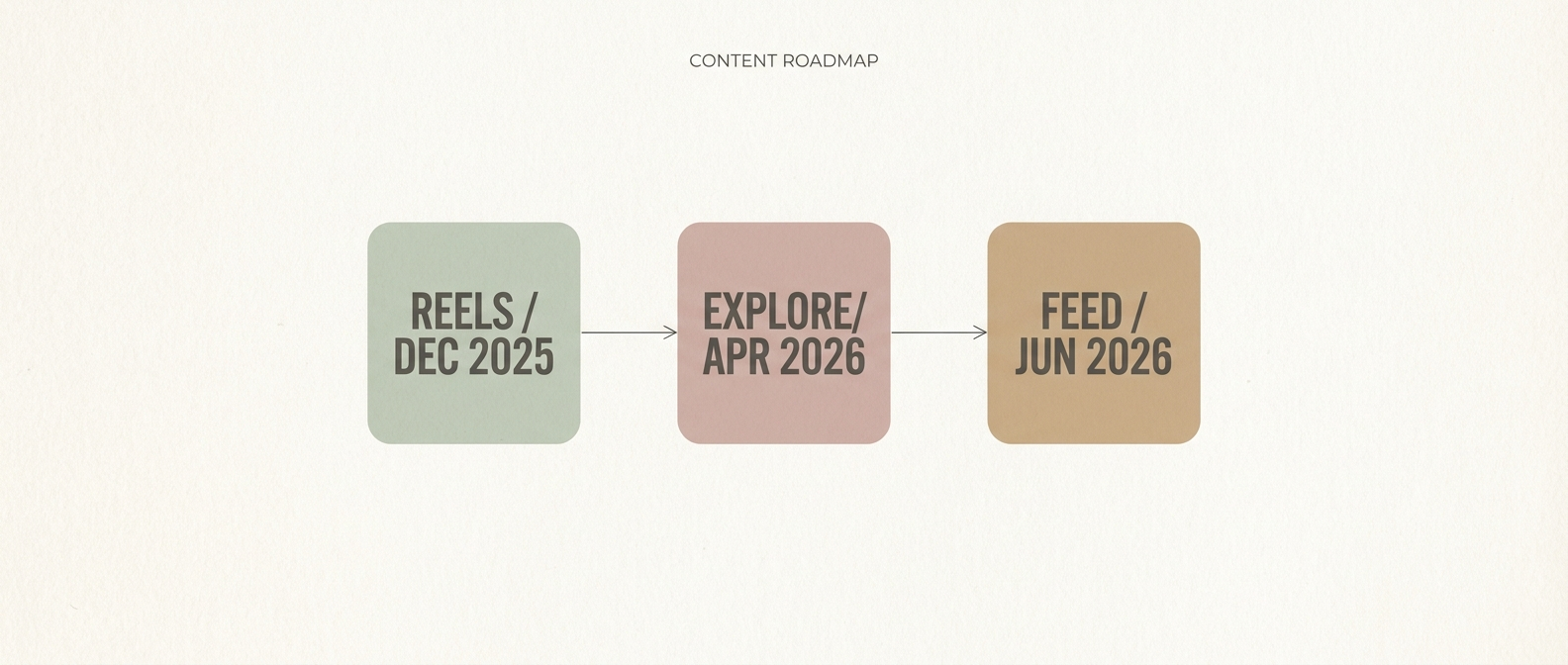
Here's the timeline most coverage missed:
- October 2025: Initial test launches for Reels in the US
- December 10, 2025: Public launch for Reels, US-wide
- April 2026: Expanded to Explore. Changes made in Explore now carry across to Reels, and vice versa — one connected preference system. The Agent Toolkit
- June 2026: Expanded to the main Feed. Users can now have a direct say over what's shown in their main feed as well. FiveBBC
Each rollout step quietly added more weight to user-declared preferences across more surfaces of the app. What started as a Reels-only experiment is now woven into virtually every place Instagram decides what to show you.
The endpoint is significant: declared interests, not just inferred ones, now shape distribution across Instagram.
Why this changes things for creators and businesses
For most of Instagram's history, content distribution was driven by inferred behaviour. The algorithm watched what users engaged with and built a predictive model around it. Creators could (and did) win reach by producing content that triggered engagement — even from users who hadn't consciously asked for it.
Your Algorithm flips that model. Now, users can actively tell Instagram what they want, in their own words.
For creators, that means relevance is no longer determined solely by engagement performance, but by how closely content aligns with clearly defined topic categories. When preferences are explicit, content that falls outside those parameters is filtered more aggressively. Trustpilot
In plainer English: if Instagram can't clearly categorise what you're about, your content becomes invisible the moment a user removes a loosely related topic.
This is the part that catches accounts off-guard. Accounts that publish across unrelated themes — travel one week, fitness the next, product reviews after that — often experience weaker audience matching and less consistent distribution. In contrast, creators who maintain a narrow, coherent topic profile are more likely to be matched with relevant audiences. Trustpilot
It also creates what one industry analyst called a "rolling identity window" — your topic positioning is no longer something built gradually over years. It's constantly being recalculated.
What Mosseri himself has said
Adam Mosseri, Head of Instagram, has been unusually direct about why this feature exists. "Who you follow used to be a meaningful tool people had for shaping their own experience, and as recommendations took over the main feed that tool quietly stopped working. The conversation with the system became one-sided. The system learns from what you tap, watch, and share, but you don't really get to tell it what you want." FiveBBC
He's also been explicit about the technical foundation: "LLMs can look at clusters of content and describe them in language people understand, which gives Instagram a way to show people what the system thinks they're interested in, and a way for them to tell the system what they actually want." REVIEWS.io
In other words: Instagram now uses large language models to describe content categories in human language, then lets users edit those categories directly. This is structurally different from any previous algorithm Instagram has run.
Niche clarity is no longer a growth strategy. It's a survival requirement.

If you take one practical lesson from this rollout, it's this.
For years, the advice has been to "niche down" — pick a clear topic, become known for it, attract a defined audience. Good advice, but historically optional. Plenty of accounts grew while posting across loosely related themes, because the algorithm could still match them to audiences through engagement signals.
That's no longer true.
In the 2026 algorithm, if your content doesn't fit a clear, AI-recognisable topic category, it becomes invisible the moment a user removes a loosely related interest. A skincare account that occasionally posts about pets, food, and gym workouts is now harder to distribute than one that posts only about skincare. Not because the content is worse — because the system can't confidently categorise it.
This is also why platform-wide reach metrics are dropping. Early 2026 data points to an ~18% drop in average organic reach. Part of that is users actively filtering out content that doesn't match their declared interests. The accounts feeling it hardest are the ones with diffuse topic profiles. REVIEWS.io
What to do about it (5 practical steps)

Here's how to actually adapt:
1. Audit your own Your Algorithm panel.
Open it. Look at the topics Instagram thinks you're into. If your own algorithm description doesn't include the niche you're trying to grow in, that's a strong signal your account isn't being categorised the way you want it to be.
2. Pick one to three core topics. Commit to them.
Not five. Not seven. One to three. The more you spread, the harder Instagram has to work to categorise you, and the more likely a user's declared preference filters you out.
3. Make sure your captions, audio, and on-screen text use clear topic language.
The algorithm now reads all three. Vague captions ("life lately ✨") give Instagram nothing to work with. Specific topic language ("3-day meal prep for high-protein eating") gets you categorised confidently.
4. Watch your own analytics for category drift.
If your reach starts dropping, check whether you've been quietly posting across too many themes. The fix is usually consolidation, not more content.
5. Don't panic-pivot.
The accounts that suffer most under this system are the ones that constantly change direction. "The algorithm wants you to be predictable, but your business needs you to be adaptable." Be deliberate about pivots when you make them — and budget for a temporary reach dip while the system relearns. Trustpilot
The part nobody's talking about
Here's the honest version. Even if you do all of the above — clear topic, consistent content, perfect categorisation — there's still a gap between Instagram being able to show your content to the right people and actually doing it consistently.
That gap is engagement. The algorithm decides who to show your content to based on who's already engaging with it. If you're a new account in a niche, the system has very little data to work with — so even perfectly-categorised content stays trapped in a small circle.
The accounts that compound fastest in 2026 do two things in parallel: they produce clearly-niched content the algorithm can categorise, and they actively put their profile in front of real people in that niche every day, building the engagement signals the algorithm needs to do its job.
That second half is what most creators don't have time for. Real human engagement with the right accounts in your niche, manually, every weekday — that's the work we do for our clients while they focus on the content side. The two halves working together is what produces consistent 300–500 relevant followers a month.

The simple version
- Your Algorithm is real. Open it. See how Instagram is categorising you.
- Declared interests now shape distribution across Reels, Explore, and Feed.
- Niche clarity is now mandatory, not optional.
- Mixed-topic accounts get penalised. Pick one to three core themes and stick to them.
- Use clear topic language in captions, audio, and on-screen text. The algorithm reads all of it.
- The accounts that compound in this system are clear in their content and active in their engagement.
Instagram's transition from inferred to declared interest is one of the most significant shifts the platform has made in years. It rewards focus, punishes drift, and makes "being everywhere a bit" the worst possible strategy.
The accounts that adapt fastest will be the ones who already understood that real growth was always about clarity and consistency — and who've been doing the engagement work to match.
If you'd like a team handling the engagement side for you while you focus on producing the clearly-niched content the new algorithm rewards, that's what we do.
See plans → from $129/month, no contract, cancel any time. 30-day money-back guarantee. 1winmd.lol